Physician-led metabolic & hormone testing · Serving NC since 2008 · Most insurance accepted
Physician-led metabolic & hormone testing · Beyond Ordinary Medicine
What We Test
Dozens of biomarkers, chosen to reveal the most complete picture of your metabolism, hormones, and long-term health.
We don't run a bigger panel to run a bigger panel. Every marker below earns its place because it explains something about how you feel, function, and age. Reading them all together is how a physician finds the cause others missed. Pick a topic to see what we measure, and why.
Choose a health area to see the specific markers we measure, what each one is, why it matters, and the range where most patients feel their best. Because your body's systems are connected, some markers appear under more than one topic. That's the point: we read them as complete one story, not a list of numbers.
All Markers
Metabolic & Blood Sugar
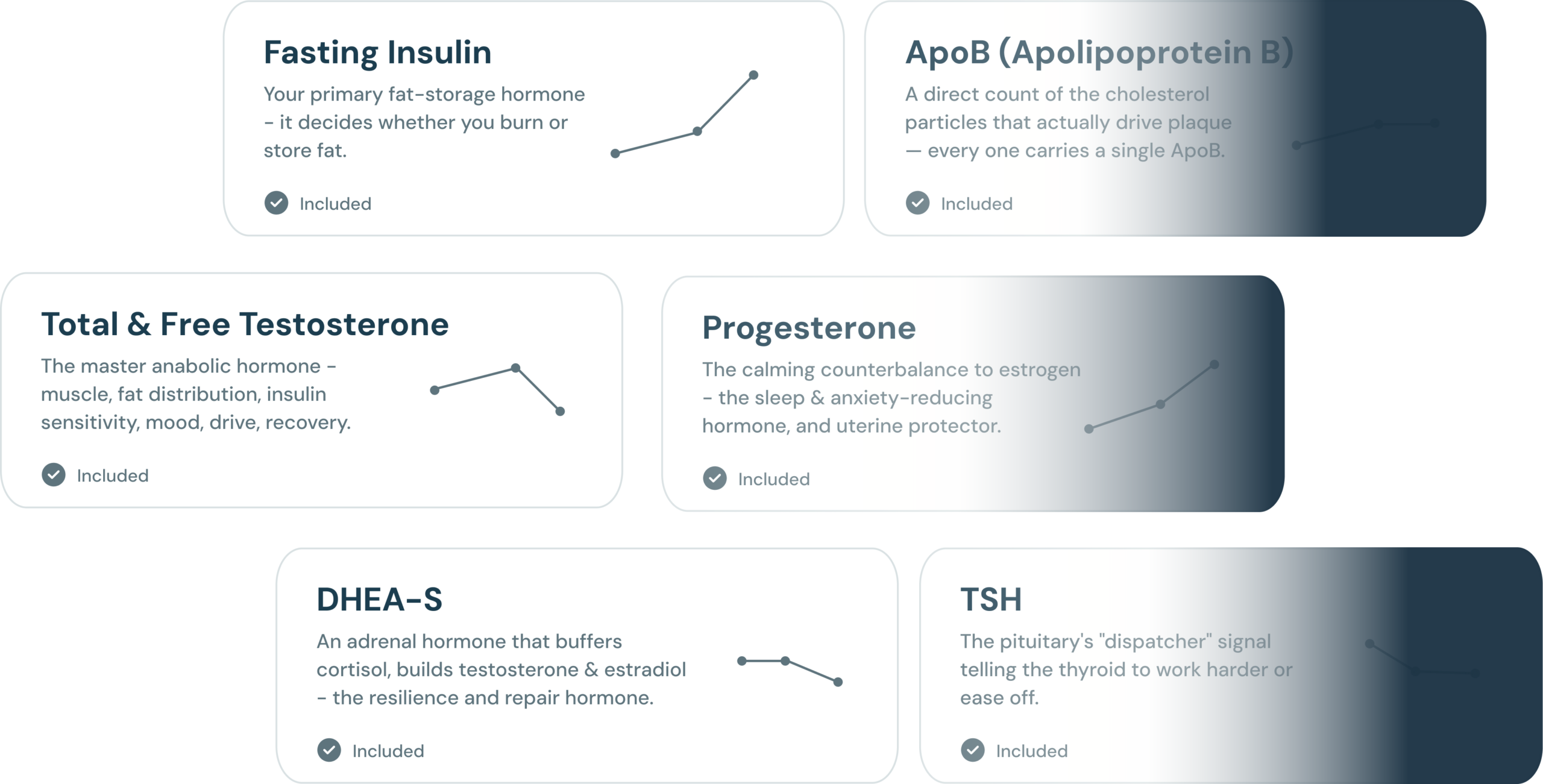
Fasting Insulin
Your primary fat-storage hormone — it decides whether you burn or store fat.
Metabolic
Weight
Hormones
Why We Test It
High insulin is the first domino of metabolic dysfunction — cravings, fatigue, and weight-loss resistance, often while glucose still looks normal.
Range Guidance
BSMD optimal: 4–8 µIU/mL (healthy < 12)
If Dr. Dave could pick one lab to predict weight-loss success, it would be fasting insulin.
Fasting Glucose
The amount of sugar in your blood after an overnight fast.
Metabolic
Weight
Why We Test It
A late warning light — by the time it rises, the pancreas has usually overproduced insulin for years. We test it, but never rely on it alone.
Range Guidance
BSMD optimal: < 90 mg/dL (healthy < 100)
Triglycerides
Circulating fat particles that rise from excess carbohydrate, alcohol, or insulin resistance.
Metabolic
Heart
Weight
Why We Test It
The strongest lipid clue to insulin resistance and an early sign of fatty liver — often years before other labs change.
Range Guidance
BSMD goal: < 100 mg/dL (> 150 greatly elevated)
HDL
So-called "good cholesterol" — really a marker of how flexible and resilient your metabolism is.
Metabolic
Heart
Why We Test It
Low HDL is one of the earliest signs of metabolic dysfunction. Paired with high triglycerides, it signals insulin resistance until proven otherwise.
Range Guidance
BSMD optimal: Men > 50 · Women > 60 mg/dL
LDL
A cholesterol transport vehicle — "bad cholesterol" is too simple a label.
Metabolic
Heart
Why We Test It
Context matters more than the number; LDL can rise for harmless reasons (including weight loss). We pair it with ApoB, triglycerides, and HDL.
Range Guidance
BSMD goal: < 100 mg/dL (interpreted in context)
New
ApoB (Apolipoprotein B)
A direct count of the cholesterol particles that actually drive plaque — every one carries a single ApoB.
Metabolic
Heart
Why We Test It
A more accurate cardiovascular-risk marker than LDL alone, especially in insulin resistance where a standard panel underestimates risk. You can have a "normal" LDL and a high particle count.
Range Guidance
BSMD optimal: < 80 mg/dL; lower (≈60–70) if higher risk — confirm target with clinical team
When the lipid panel looks "fine" but the metabolic markers don't, ApoB usually tells the real story.
Leptin
Your fat cells' signal to the brain about stored fuel — the "weight thermostat."
Metabolic
Weight
Hormones
Why We Test It
When leptin stays high too long, the brain stops listening (leptin resistance) — driving cravings, plateaus, and regain. Helps predict whether weight loss will hold.
The pituitary's "dispatcher" signal telling the thyroid to work harder or ease off.
Thyroid
Why We Test It
Useful but slow, and easily thrown off by dieting, stress, and inflammation. We never interpret it alone.
Range Guidance
BSMD optimal: 0.5–2.0 µIU/mL (standard 0.4–4.5)
Free T4
The storage form of thyroid hormone — inactive until converted to T3.
Thyroid
Why We Test It
Normal T4 with symptoms usually points to a conversion problem, not a production one.
Range Guidance
BSMD optimal: 0.9–1.2 ng/dL (standard 0.8–1.8)
Free T4 is your savings account; Free T3 is your checking account. You can't spend what you can't convert.
Free T3
The active thyroid hormone that enters every cell and sets your metabolic speed.
Thyroid
Weight
Why We Test It
The strongest hormonal predictor of energy, weight-loss capability, and mental sharpness. Low Free T3 explains feeling cold, tired, foggy, and plateaued.
Range Guidance
BSMD optimal: 3.0–4.4 pg/mL (standard 2.3–4.2)
TPO Antibodies
A marker of whether your immune system is targeting your thyroid.
Thyroid
Autoimmune
Why We Test It
Even a mild elevation — long before a Hashimoto's diagnosis — signals inflammation that impairs conversion and predicts future dysfunction.
Range Guidance
BSMD flag: elevated > 10 IU/mL (standard < 35)
Men's Hormones
SHBG
The transport protein that decides how much of your hormone is free (active) vs. bound (inactive).
Men's Hormones
Women's Hormones
Metabolic
Why We Test It
Two people with identical total hormone can feel completely different depending on SHBG. It also reflects metabolic and liver health — low SHBG is an early flag for insulin resistance.
Range Guidance
BSMD focus: interpreted by symptoms + metabolic status (typical ~15–70 nmol/L)
When symptoms don't match the numbers, SHBG almost always reveals the truth.
Men need estrogen too — made from testosterone, essential for libido, bone, mood, and heart.
Men's Hormones
Why We Test It
Both too-high and too-low matter; too low is often more damaging. We balance it, not eliminate it.
Range Guidance
BSMD goal ratio: Testosterone:Estradiol ≈ 10–20:1
New
LH — Luteinizing Hormone
The pituitary's signal that drives sex-hormone production — the "diagnostic compass."
Men's Hormones
Women's Hormones
Diagnostic
Why We Test It
In men, it tells us whether low testosterone is a testicular vs. a pituitary/metabolic problem — and whether TRT is even the right answer. In women, it works with FSH and estradiol to map the perimenopause transition.
Range Guidance
Men: high LH+low T = testicular; low LH+low T = pituitary/metabolic; on TRT typically < 1. Women: read with FSH + estradiol.
Prolactin
A pituitary hormone that, when elevated, can quietly suppress testosterone and libido.
Men's Hormones
Diagnostic
Why We Test It
In a man with low libido out of proportion to his testosterone, prolactin often uncovers a pituitary cause long before imaging would.
A potent androgen influencing libido, drive, and (in predisposed men) hair loss.
Men's Hormones
Why We Test It
Helps interpret symptoms and TRT response; usually only a concern when symptomatic.
Range Guidance
Interpreted alongside testosterone and symptoms
Women's Hormones
Estradiol
The master female hormone — it protects the brain, bones, heart, metabolism, and mood.
Women's Hormones
Metabolic
Why We Test It
Falling estradiol drives the classic cluster (hot flashes, insomnia, anxiety, midsection weight gain, fog) and raises insulin resistance and cardiovascular risk. A metabolic hormone, not just a "symptom" one.
Range Guidance
BSMD optimal (on replacement): 60–120 pg/mL (menopause typically < 30)
Progesterone
The calming counterbalance to estrogen — the sleep and anxiety-reducing hormone, and uterine protector.
Women's Hormones
Sleep
Why We Test It
The first hormone to decline in perimenopause. Low progesterone shows up as 2–3 a.m. waking, anxiety, and heavier or irregular cycles.
Range Guidance
BSMD optimal (on replacement): individualized; goal > 3 ng/mL
"I fall asleep fine but wake up wired at 2 a.m." — low progesterone is almost always part of that story.
Testosterone (in women)
The often-missing ingredient — confidence, motivation, lean muscle, bone density, clarity, and libido.
Women's Hormones
Weight
Why We Test It
Women lose up to 80–90% of testosterone production by their late 40s/early 50s — one of the most under-tested causes of "I don't feel like myself."
Range Guidance
BSMD optimal: Free T 2–4 pg/mL (by symptoms)
FSH
The signal that rises as the ovaries lose their ability to make estradiol — the menopause marker.
Women's Hormones
Diagnostic
Why We Test It
With estradiol, it distinguishes true menopause from stress/under-eating suppression that can look the same on the surface.
An adrenal hormone that buffers cortisol and builds testosterone and estradiol — the resilience and repair hormone.
Adrenal
Foundational
Why We Test It
Low DHEA-S looks like "exhausted but wired" — drained by day, unable to switch off at night, slow to recover. It worsens insulin resistance and makes thyroid harder to balance.
Range Guidance
Supports stress tolerance, sleep, mood, immunity, and mitochondrial energy
Vitamin D
Not really a vitamin — a master regulatory hormone with receptors on nearly every cell.
Foundational
Autoimmune
Why We Test It
Low vitamin D ripples across thyroid sensitivity, insulin resistance, leptin signaling, immune balance, mood, and inflammation. Often the first thing we optimize when a thyroid plan stalls.
Range Guidance
BSMD optimal: 40–60 ng/mL (pair with vitamin K2)
Ferritin
Your stored iron — a window into energy, oxygen delivery, and thyroid conversion.
Foundational
Thyroid
Energy
Why We Test It
The most sensitive early marker of low iron. It drops months to years before hemoglobin. Low ferritin mimics thyroid disease and is required to convert T4 into active T3.
Range Guidance
BSMD goal: > 50 ng/mL (many feel best 70–100)
Correcting ferritin often transforms thyroid function and eliminates fatigue.
No matching tests found.
How to read these ranges. Ranges are general educational guidance, not a diagnosis. Standard "normal" ranges screen for disease; Blue Sky MD often targets a tighter "optimal" range — where you feel and function best. Your provider interprets your results in the context of your symptoms, history, and goals.
Why we read them together
No single number tells the whole story.
The power of our lab panels isn't in any one marker. The pattern tells us what's really going on. High insulin, high triglycerides, low HDL, low Free T3, low ferritin, and shifting sex hormones can each look "borderline" on their own and get dismissed. Read together, they tell a clear story, and help us create an effective treatment strategy. That's what a physician does with your results that an algorithm and a "normal/abnormal" flag never will.
A real pattern anonymized, from our clinical guide
A 49-year-old with fatigue, midsection weight gain, 2–3 a.m. waking, and hair thinning had a “normal” glucose and TSH. However, elevated insulin and leptin, low Free T3 with mildly elevated TPO antibodies, low ferritin and vitamin D, and perimenopausal estradiol and testosterone. No single result was alarming. Together, they explained everything she was feeling, and mapped a plan.
Where does testing fit into the process as a whole?
Lab testing is an important part of how we customize your care. To put our process simply in a few sentences: You'll start with a quick free assessment, we'll get some baseline measurements via your labs, and then a physician explains what it means. Then we'll build a plan together as part of a dialogue.
A comprehensive core panel is standard; your provider may add or adjust markers based on your symptoms, history, and goals. The explorer above shows the range of what we measure.
Why do you use different ("optimal") ranges than my last doctor?
Standard ranges are built to flag disease. We also look at where patients actually feel and function best — which is often a tighter range. A result inside "normal" can still be the reason you feel off.
Is testing covered by insurance?
Many visits and labs may be billed through your insurance depending on your plan; we'll help verify your benefits. Affordable self-pay and HSA/FSA options are available. The Health Assessment is free.
Can I understand my results on my own?
You'll never have to. A Blue Sky MD provider walks you through what each marker means for you — that conversation is the whole point of testing.
Start here
Curious what your numbers would reveal?
These markers are how we find the cause others missed — and how we build a plan that's actually yours. It starts with a free, ~3-minute Health Assessment.