
By Dr. David LaMond Founder and Medical Director, Blue Sky MD | Medical Director, DermaBlue
Over the past few years, I have watched an entirely new pattern walk into our clinic.
Women in their 40s and 50s start a GLP-1 medication, i.e. semaglutide (Ozempic, Wegovy) or tirzepatide (Mounjaro, Zepbound), and often lose 20, 40, sometimes 60 pounds. They feel better. Their labs improve. Their joints hurt less. And then they look in the mirror and see a face that seems to have aged five years in five months.
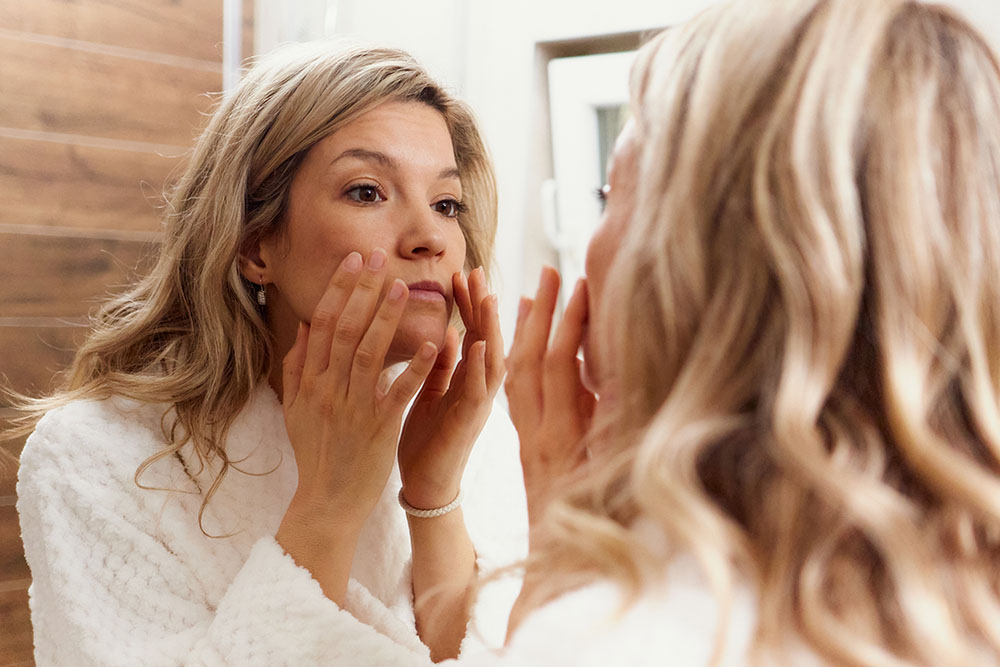
Sunken cheeks. A hollow, tired look around the eyes. Loose skin along the jawline and neck that wasn’t there before the weight loss. Patients call it “Ozempic face,” and the term has become so common that most people now recognize it without an explanation.
Here is the clinical pattern I have noticed, and it is one I do not see discussed often enough:
Women who lose weight on GLP-1 medications during perimenopause or menopause tend to develop more visible facial sagging than women of similar age and weight loss who are not in the menopausal transition.
This is not simply a coincidence of timing. There is a biological reason two things happening in the same body at the same time (in this case: rapid fat loss and declining estrogen) can compound each other in ways that are worse than either one alone.
This article is about that overlap. It is written for the growing number of women who are managing weight with a GLP-1 medication while also navigating perimenopause or menopause, and who want to understand why their skin is responding the way it is, and what can actually be done about it.
“Ozempic Face” Is Real, and the Mechanism Is More Than Just Volume Loss
Most explanations of Ozempic face stop at a simple idea: you lost fat from your face, so now there is less padding under the skin, and the skin looks loose because it hasn’t caught up.
That part is true. Rapid fat loss removes structural volume from the cheeks, temples, and jawline faster than the skin can remodel and tighten around the new, smaller framework. When weight comes off quickly, the skin often does not have time to contract the way it might after a slower, more gradual loss.
But there is a second mechanism that gets far less attention, and it is one I find clinically important.
Facial fat is not just a passive cushion. The stem cells within that fat (adipose-derived stem cells, or ADSCs) actively support the skin’s ability to produce collagen, elastin, and hyaluronic acid.
Some dermatologists who study this closely have described how GLP-1 medications appear to act directly on these cells, reducing their glucose uptake and, with it, their ability to build the very structural proteins that keep skin firm.
In other words, some of what we are calling “Ozempic face” may not be simple deflation. It may be a change in how well the skin can repair and rebuild itself while the medication is active.
The Connection I’ve Noticed with Estrogen
Here is where menopause enters the picture in a way I think deserves much more attention than it currently receives.
Fat tissue is not only a storage depot for calories. It is also an active hormone-producing organ. Adipose tissue contains an enzyme called aromatase, which converts other hormones into estrogen locally, within the fat itself. After menopause, when the ovaries largely stop producing estrogen, this peripheral, fat-derived estrogen becomes a meaningfully larger share of a woman’s total estrogen exposure.
A recent endocrinology review raised another possibility.
GLP-1 medications, by aggressively reducing fat mass, may also reduce this local estrogen production from adipose tissue. Lower local estrogen means less support for collagen synthesis in the skin, compounding the collagen loss that menopause has already caused.
Read that again, because it is the core clinical insight behind this article:
A menopausal woman losing weight on a GLP-1 medication may be reducing her estrogen supply from two directions at once—the natural decline of menopause, and the loss of estrogen-producing fat tissue itself.
This is what I mean when I say the two conditions can compound each other. It is not simply “menopause skin” plus “weight loss skin.” It may be a genuinely amplified effect, where the very tissue lost to achieve a healthier weight was also quietly supporting the skin’s remaining hormonal foundation.
I want to be careful here. This mechanism is described in early review literature, not confirmed with large controlled trials in menopausal women specifically. Research on this connection is still developing, and individual response clearly varies. But it is consistent with what I am seeing clinically, and it gives us a rational, biological reason to take this pattern seriously rather than treating it as coincidence.
What I See in Perimenopausal and Menopausal Women on GLP-1 Medications
Clinically, the women in this overlap group often show a distinct pattern that differs from what I see in younger patients losing similar amounts of weight:
- Hollowing of the cheeks and temples that appears earlier and more dramatically
- A jawline that softens and loosens rather than simply becoming more defined
- Increased crepiness and thinning through the neck and décolletage
- Under-eye hollowing that makes patients look chronically tired
- Skin that looks dull and dehydrated in addition to being looser
- Slower visible improvement from standard skin care during active weight loss
- A sense, in the patient’s own words, of looking older rather than simply thinner
- Some overlap with hair shedding, since both are downstream of rapid weight loss and nutritional shifts during GLP-1 therapy
I have already written a fair amount about the hair shedding some patients experience on GLP-1 medications, which is typically a temporary shift called telogen effluvium related to rapid weight loss rather than a direct effect of the drug.
I mention it because it is a useful clue. If a patient’s hair is shedding, her skin is very likely under similar metabolic stress, and both deserve attention at the same time rather than being treated as separate, unrelated complaints.
Why Some Women Age Faster on GLP-1s Than Others
Not every woman on a GLP-1 medication develops significant facial sagging, and not every menopausal woman on one develops it either. In my experience, several factors seem to determine who is most affected:
Speed of weight loss.
Faster loss generally gives the skin less time to remodel. Patients losing weight very quickly, or those on higher doses without a structured taper, tend to show more visible laxity.
Total amount of weight lost.
Larger total losses naturally remove more structural volume, and the face has relatively little fat to spare compared with other areas of the body.
Baseline hormone status.
Women who are already estrogen-deficient before starting a GLP-1 medication may have less reserve capacity to compensate for the additional stress on collagen production.
Protein intake and lean mass preservation.
Inadequate protein during rapid weight loss contributes to loss of muscle as well as fat, which removes additional structural support from the face.
Baseline skin quality, sun history, and genetics.
As with any form of facial aging, these set the starting point everyone works from.
Age.
Skin’s baseline capacity to remodel and recoil declines with age regardless of hormone status, so the same weight loss tends to show more in a 55-year-old than in a 32-year-old.
This is why I do not believe there is one single explanation, or one single fix. It is also why I think a woman starting a GLP-1 medication during perimenopause or menopause benefits from a different level of planning than a younger patient might need.
Slowing (or Preventing) the Sagging Before It Happens
Some of the most effective interventions for GLP-1-related facial aging happen before significant weight is lost, not after.
Properly pacing the weight loss
Working with your prescribing clinician to titrate dose and rate of loss, rather than losing weight as fast as biologically possible, gives skin more opportunity to remodel along the way.
Prioritizing protein and lean mass preservation
Adequate protein intake, generally targeted around the range of one gram per pound of ideal body weight, helps preserve lean mass and gives the body the raw material it needs for tissue repair, including in the skin.
Resistance training
Maintaining and building muscle mass supports the structural framework under the skin, particularly in the face, neck, and jawline.
Addressing micronutrients
Deficiencies in protein, ferritin, zinc, vitamin D, and B vitamins can worsen both hair shedding and skin quality during rapid weight loss, and are worth checking rather than assuming.
Evaluating hormones rather than assuming menopause is “just happening.”
This is where I believe the conversation is most often missing. A woman beginning a GLP-1 medication in her 40s or 50s should have her estrogen, progesterone, testosterone, and thyroid function evaluated as part of the plan, not as an afterthought once her face already looks different.
None of this guarantees a woman will avoid facial changes entirely. But in my experience, women who plan for this proactively, rather than reacting to it after the fact, generally end up with better-supported skin and an easier time correcting what does occur.
Why Hormone Evaluation Belongs in the GLP-1 Conversation
If declining estrogen, from menopause and potentially from the loss of hormone-producing fat tissue, is part of why skin struggles to keep up during GLP-1-driven weight loss, then addressing hormone status is a reasonable part of addressing the problem. This is the piece of the puzzle we focus on at Blue Sky MD.
When a woman comes to us for GLP-1 weight loss management, we evaluate estrogen, progesterone, testosterone, and thyroid function alongside her metabolic health, and we coordinate that evaluation with her GLP-1 treatment plan rather than treating hormones and weight loss as unrelated tracks of care. This includes attention to body composition, lean mass preservation, and the nutritional factors that influence both skin and hair during rapid weight loss.
This is not a claim that hormone therapy prevents Ozempic face, and I want to be direct about that.
No controlled study has yet tested whether treating estrogen deficiency changes facial aging outcomes specifically in women losing weight on GLP-1 medications. That research does not exist yet. What does exist is a plausible, biologically grounded reason to have the hormone conversation at the same time as the weight loss conversation, rather than waiting until a patient is already unhappy with how she looks in the mirror.
What Can Be Done About the Skin Changes Themselves
Hormone and metabolic management is where Blue Sky MD focuses, but it is not the whole answer once volume and firmness have already been lost. For that, we refer patients to our sister practice, DermaBlue, which approaches collagen-deficient, volume-deficient skin with a combination of structural support and collagen stimulation.
Biostimulatory injectables
These work by encouraging the body to rebuild its own collagen gradually over months, rather than simply adding temporary volume. They are particularly well suited to the hollowed cheeks and temples common in GLP-1-related facial change, because they rebuild structural support rather than masking its absence.
Hyaluronic acid fillers
For patients who need more immediate contouring alongside a longer-term collagen-building plan, filler can restore volume to specific areas while biostimulatory treatments work in the background.
RF microneedling and XERF. XERF delivers controlled radiofrequency energy into deeper supportive tissue to stimulate gradual collagen remodeling, which can help address the loose, crepey skin along the jawline and neck that volume replacement alone does not fully correct. Traditional and radiofrequency microneedling create a similar collagen-building stimulus at a more superficial level, and are useful for texture and mild-to-moderate laxity across the face and neck.
Medical-grade skin care. Because GLP-1-related skin often looks dehydrated as well as loose, a supportive daily skin care regimen matters more here than it might for a patient whose only concern is a static wrinkle.
As with any collagen-building treatment, results depend on the body’s ability to respond to the stimulus provided. This is precisely why we don’t see the hormone side and the aesthetic side as separate conversations. They are two parts of the same treatment plan, in my mind.
Why Blue Sky MD Partners With DermaBlue
This is the same collaborative model I have described before, applied to a newer problem.
Blue Sky MD treats the patient from the inside out. We evaluate hormone status, thyroid function, nutrition, and the metabolic environment that determines how well a woman’s body, including her skin, can handle significant weight loss.
DermaBlue treats the skin from the outside in. Their team assesses volume loss, laxity, texture, and the visible consequences of rapid weight change, and builds a treatment plan using the tools designed to rebuild collagen and restore structure.
A woman who is losing weight on a GLP-1 medication during perimenopause or menopause is, in my view, better served when both sides of this picture are being managed together rather than separately. We can look for the reasons her face is changing. DermaBlue can address what she sees in the mirror.
Who Should Consider a Combined Evaluation?
A combined hormone and skin evaluation may be worth considering if you are on a GLP-1 medication and experiencing any of the following, particularly during perimenopause or menopause:
- Noticeable hollowing of the cheeks, temples, or under-eye area
- New or worsening jowling and jawline laxity
- Crepey or thinning skin in the neck and décolletage
- Skin that looks dull, dehydrated, or “tired” despite consistent skin care
- Increased hair shedding alongside facial changes
- Rapid weight loss, particularly more than one to two pounds per week sustained over months
- Hot flashes, sleep disruption, low energy, or other menopausal symptoms appearing or worsening alongside the weight loss
- A sense that you look meaningfully older than you did before starting treatment, not just thinner
Women should not be told this is simply an unavoidable tradeoff for the health benefits of weight loss. In many cases, more can be done, and it works best when addressed early rather than after significant change has already occurred.
My Approach
I am not opposed to GLP-1 medications. I have seen them meaningfully improve patients’ metabolic health, joint function, energy, and long-term risk profile. My concern is narrower: that the skin and hormone consequences of rapid weight loss are being addressed too late, or not at all, in a population of women who are already managing a separate hormonal transition.
My approach for a woman in this situation generally follows a straightforward sequence:
- Evaluate hormone and metabolic status here at Blue Sky MD before or early in GLP-1 treatment, including estrogen, progesterone, testosterone, and thyroid function.
- Establish a weight loss pace and nutrition plan, particularly protein intake, designed to protect lean mass and skin quality, not just the number on the scale.
- Address hormonal support when medically appropriate, alongside the GLP-1 medication rather than instead of it.
- Refer to our sister practice, DermaBlue, to monitor facial volume and skin quality throughout the weight loss process, rather than waiting until change is already significant.
- Rebuild lost volume and collagen at DermaBlue with the appropriate combination of biostimulatory treatment, filler, or XERF, once weight loss has stabilized.
Losing weight and looking healthy should not have to be in conflict. In my experience, they usually aren’t, when the plan accounts for both from the start.
Schedule a Personalized Consultation
If you are on a GLP-1 medication, or considering one, and want a plan that protects your skin as well as your health, Blue Sky MD offers a comprehensive hormone and metabolic evaluation alongside your weight loss management, rather than treating them as separate conversations.
Explore hormone therapy for women at Blue Sky MD >>
Learn about GLP-1 weight loss management at Blue Sky MD >>
Contact Blue Sky MD to get started >>
Women who are already noticing facial volume loss or skin laxity can also connect with our sister practice for a complimentary aesthetic consultation, with locations in Asheville and Hendersonville.
Schedule a free DermaBlue aesthetic consultation >>
Dr. David LaMond Founder and Medical Director, Blue Sky MD Medical Director, DermaBlue
Questions patients ask about Ozempic Face
Is "Ozempic face" a real medical phenomenon?
Yes, in the sense that clinicians widely observe facial volume loss and skin laxity in patients who lose significant weight quickly on GLP-1 medications. It describes a pattern of visible change rather than a single diagnosed condition, and its severity varies widely from patient to patient.
Does menopause make Ozempic face worse?
In my clinical experience, yes, women in perimenopause or menopause often show more pronounced facial changes than younger patients losing similar amounts of weight. A possible explanation involves the loss of estrogen-producing fat tissue compounding the estrogen decline of menopause itself, though this specific interaction has not been directly studied in controlled trials
Does GLP-1 weight loss actually damage collagen, or is it just volume loss?
Both appear to play a role. Volume loss from reduced facial fat is the more visible driver, but some research suggests GLP-1 medications may also directly affect the stem cells within fat tissue that support collagen and elastin production, which could impair the skin’s own repair capacity during treatment.
Can hormone therapy prevent or reverse Ozempic face?
This has not been directly studied, and I want to be clear that no one can promise that outcome. What is reasonable is evaluating and addressing hormone deficiencies as part of an overall plan, since estrogen supports collagen production broadly, and doing so may help provide a better foundation for skin during weight loss.
What treatments help with skin sagging after GLP-1 weight loss?
Our sister practice, DermaBlue, typically uses a combination of biostimulatory injectables to rebuild lost collagen, hyaluronic acid filler for immediate volume, and RF microneedling or XERF for skin tightening, chosen based on where a patient has lost the most structural support. At Blue Sky MD, our role is making sure the hormonal and nutritional foundation supports that work.
How can I reduce my risk of Ozempic face before I lose weight?
Pacing your weight loss, prioritizing protein intake, maintaining muscle through resistance training, and having your hormone and micronutrient status evaluated early are the most practical steps I recommend.
Should I get my hormones checked before starting a GLP-1 medication?
If you are in your 40s or 50s, I believe this is worth doing, particularly if you are also experiencing menopausal symptoms. It allows any hormone-related contribution to skin and hair changes to be addressed proactively rather than after the fact.